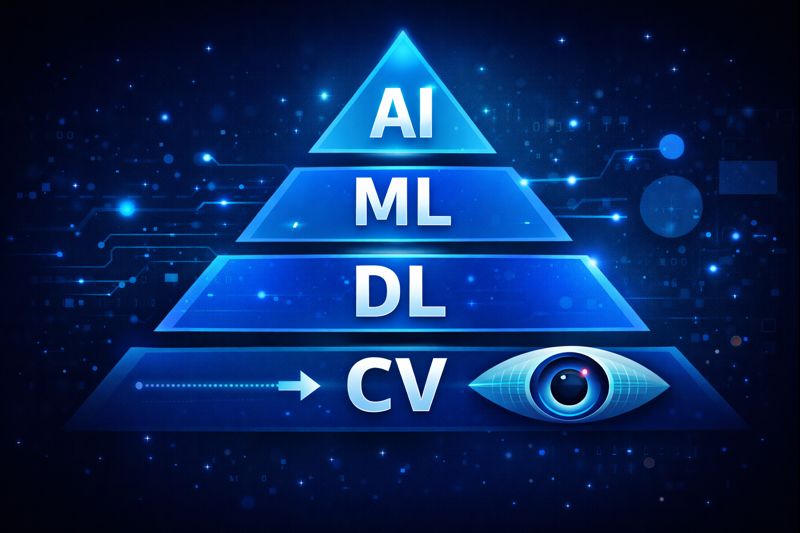
These four terms get thrown around almost interchangeably in casual conversation, and that's part of why so many people find the field confusing. They're not synonyms — they're nested inside each other, like a set of Russian dolls, each one a more specific technique than the one before it. Once that structure clicks, a lot of the jargon in AI news articles stops being intimidating.
The nesting, in order
Artificial Intelligence is the broadest category: any system that performs tasks we'd normally associate with human intelligence. That includes everything from a chess program running hand-coded rules in the 1990s to a modern chatbot.
Machine Learning is a subset of AI where, instead of hand-coding rules, you feed the system examples and let it find patterns on its own. A spam filter that improves as it sees more flagged emails is machine learning.
Deep Learning is a subset of machine learning that uses neural networks with many layers ("deep" refers to the number of layers, not the sophistication). These layered networks are what made modern image recognition, speech transcription, and large language models possible, because they can automatically learn which features in raw data actually matter, rather than requiring a human to hand-engineer them.
Computer Vision is an application area, not a technique. It's the specific problem of getting a machine to interpret images and video — and today, the dominant way to solve that problem is with deep learning, specifically a type of neural network called a convolutional neural network (CNN), which is built around scanning small patches of an image to detect edges, shapes, and eventually whole objects.
So the relationship looks like this: AI contains machine learning, machine learning contains deep learning, and computer vision is a real-world problem that deep learning happens to be extremely good at solving right now.
Why the distinction actually matters
Not every problem needs deep learning, and treating it as the default is a common and expensive mistake. If you're predicting house prices from square footage, number of bedrooms, and location, a simple regression model or a decision tree from a library like scikit-learn will likely outperform a neural network, train in seconds instead of hours, and be far easier to explain to a stakeholder who wants to know why the model made a particular prediction.
Deep learning earns its complexity when the input is high-dimensional and unstructured — raw pixels, audio waveforms, or free-form text — where hand-crafting features would be impractical. That's exactly the kind of data computer vision and natural language processing deal with, which is why deep learning became the default approach in those specific fields rather than across the board.
The Python ecosystem behind most of this
Python became the de facto language for this entire field, mostly because its libraries got good early and the community kept building on top of each other instead of starting over. A few worth knowing:
- NumPy and pandas handle the unglamorous but essential work of loading, cleaning, and manipulating data before any model ever sees it.
- scikit-learn covers classical machine learning — regression, decision trees, clustering — and is usually the right starting point before reaching for anything heavier.
- TensorFlow (built by Google) and PyTorch (built by Meta) are the two dominant deep learning frameworks. PyTorch has become the preferred choice in research and increasingly in production because of its more intuitive, debuggable style; TensorFlow still has a strong footprint in large-scale enterprise deployment.
- OpenCV is the standard toolkit for classical computer vision tasks — image transformations, edge detection, video processing — and is often used alongside a deep learning model rather than instead of one.
None of these tools require you to understand the underlying linear algebra to get started, which is a big part of why the field has grown so quickly. You can train a working image classifier on a few hundred labeled photos using PyTorch and a pretrained model in an afternoon — something that would have taken a research team months just fifteen years ago.
How this plays out in a real project
Say a retailer wants to automatically detect damaged packages on a conveyor belt using camera footage. That's a computer vision problem. The team would likely start with a pretrained CNN — something like a ResNet or YOLO model, both freely available — and fine-tune it on a few thousand labeled photos of damaged versus intact packages, rather than training a network from scratch, which would require far more data and compute than most companies have on hand.
Notice how many layers of the stack that one project touches: it's an AI application, solved with machine learning, specifically deep learning, applied to the computer vision problem of image classification, built in Python using PyTorch and OpenCV. That's the whole nested structure in a single practical example.
The takeaway
AI is the destination; machine learning, deep learning, and computer vision describe increasingly specific routes for getting there. Understanding which layer you're actually talking about — and which one a given problem actually needs — is the difference between choosing a tool that fits the job and reaching for a neural network because it sounds impressive in a pitch deck.
Further reading: the official PyTorch tutorials, Google's Machine Learning Crash Course, and the OpenCV documentation for hands-on computer vision examples.