Artificial intelligence has become one of those terms that gets slapped on everything from a genuinely groundbreaking product to a glorified if-statement in a marketing email. That overuse has made the phrase almost meaningless in casual conversation, which is a shame, because the underlying technology is doing real, measurable work inside a lot of businesses right now — just usually in quieter, less flashy ways than the demos suggest.
So let's start with a plain definition and work outward from there.
What AI actually means
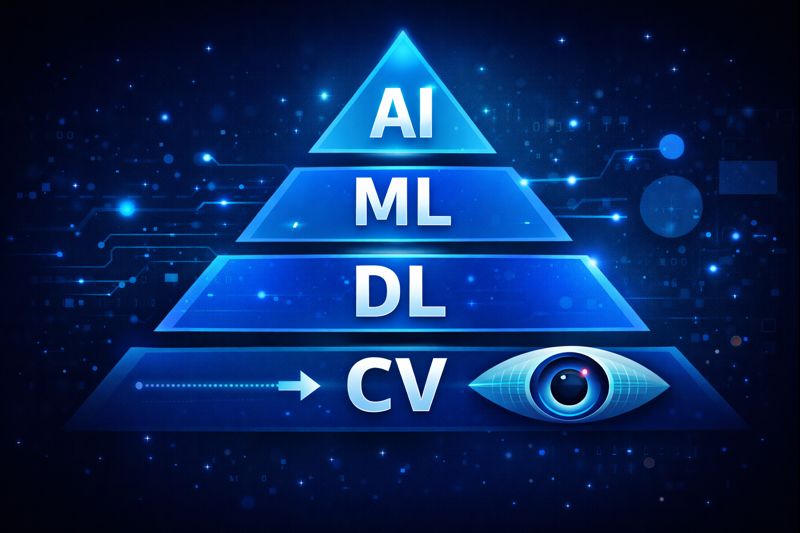
At its core, artificial intelligence is software that performs tasks which normally require human judgment: recognizing an image, understanding a sentence, predicting what happens next, or deciding between options based on incomplete information. Almost all of the AI in commercial use today falls under a narrower umbrella called machine learning, where a system learns patterns from historical data rather than following instructions a programmer wrote by hand.
Within machine learning, the technique behind most recent breakthroughs — including tools like ChatGPT and Claude — is called deep learning, which uses layered neural networks loosely inspired by how neurons connect in the brain. Stanford's Institute for Human-Centered AI publishes an annual index tracking exactly how fast this field is moving, and the pace over the last three years has genuinely been unusual even by tech industry standards.
It's worth clearing up a couple of common myths while we're here:
- AI is not one thing. A spam filter, a self-driving car's perception system, and a chatbot are all "AI," but they share almost no code or architecture in common.
- AI does not "understand" in the way people do. These systems are extremely good at pattern matching at scale. That produces impressive results, but it is a different kind of intelligence than human reasoning, and it fails in different, sometimes surprising ways.
- Most business AI is narrow, not general. A model trained to detect fraud cannot write your marketing copy, and a model that writes marketing copy cannot detect fraud. General-purpose systems like large language models are the closest thing to an exception, and even they have clear limits.
How businesses are actually using it
Set aside the futuristic pitch decks for a moment. Here is where AI is showing up in day-to-day operations across industries right now.
Customer service and support
AI-powered chat and voice systems now handle a meaningful share of first-line support inquiries — password resets, order status checks, basic troubleshooting — before handing off anything complicated to a human agent. Done well, this shortens wait times without making customers feel like they're talking to a wall. Done poorly, it's the reason people mash "0" trying to reach a person.
Sales and marketing
Predictive lead scoring, personalized product recommendations, and dynamic pricing all run on machine learning models trained on historical purchase and browsing data. Retailers like Amazon built entire businesses around recommendation engines; smaller companies now access similar capability through platforms like Salesforce Einstein or HubSpot's AI tools without building anything from scratch.
Operations and supply chain
Demand forecasting models help retailers and manufacturers figure out what to stock and where, reducing both overstock and stockouts. Logistics companies use route optimization models that account for traffic, weather, and delivery windows simultaneously — a problem with too many variables for a human dispatcher to solve by hand in real time.
Finance and fraud detection
Banks and payment processors run transactions through fraud detection models that flag anomalies in milliseconds, a task that used to rely on much cruder rule-based thresholds that were easier for fraudsters to work around. The same pattern-recognition approach powers credit risk scoring and algorithmic trading.
Content and knowledge work
This is the newest and fastest-growing category. Large language models now assist with drafting emails, summarizing meetings, generating first-draft reports, and searching internal documentation in plain language instead of exact keyword matches. McKinsey's State of AI research has tracked adoption of generative AI specifically climbing faster than any previous wave of enterprise software, with most organizations reporting measurable time savings even in early-stage deployments.
Where businesses are getting it wrong
Not every AI initiative pays off, and the failure patterns are pretty consistent. Companies deploy a model without a clear owner for monitoring its accuracy over time, so it quietly drifts and gets worse as real-world data shifts away from what it was trained on. Others chase AI for tasks that were never the bottleneck in the first place, adding complexity without solving anything. And a fair number of projects stall because the underlying data was too messy or incomplete for any model to learn from — a problem IBM's own research on enterprise AI adoption calls out repeatedly as the single biggest barrier to getting value out of these systems.
The organizations that do this well tend to start small, pick a specific, measurable problem, and expand only after proving the model actually moves a real business metric. That's a far less exciting story than "we deployed AI across the enterprise," but it's the one that actually works.
What this means going forward
AI is not going to replace every job or solve every problem, despite what either the hype cycle or the doom cycle would have you believe. What it is doing, steadily and less dramatically than the headlines suggest, is taking over specific, well-defined tasks that involve pattern recognition at scale — freeing people up for the parts of work that still require judgment, context, and a human relationship. Businesses that treat it that way, as a tool for specific problems rather than a magic fix for all of them, tend to be the ones seeing real returns.
Further reading: Stanford HAI's AI Index Report, McKinsey's State of AI survey, and IBM's overview of artificial intelligence in business.